 Gaurav Sabharwal
Guide to Objective and Key Results – OKR Meaning and Examples
It starts young when people around you ask, “When you grow up, what do […]
Learning from running an e-commerce company is one plain fact: progress only occurs when groups collaborate. Each department plays its part, but actual growth occurs when their actions are aligned.
That’s why I prefer to divide OKRs into the nine fundamental departments most e-commerce businesses bank on. Rather than arbitrary to-dos, every set contains 3–5 definite objectives that not only propel their own targets but also assist other teams.
When OKRs are aligned, marketing is providing feedback to the product, customer service is working together with operations, and finance ensures growth is sustainable. It’s not about one team winning anymore, it’s about the entire company progressing as one.
OKRs to me aren’t about creating lengthy lists that hang in a document. They’re about providing each team with a clear line of sight to how their work is related to the larger picture.
At the end of the day, no department can thrive on its own. The real impact shows up when everyone is pulling in the same direction and that’s exactly what OKRs make possible.
Objective: Increase the company’s overall profitability by 10% this year
Owner: Founder
Period of time: 1 year
Key Results:
Objective: Grow the company’s market share by 3% this year
Owner: Founder
Period of time: 1 year
Key Results:
Objective: Mitigate the impact of price wars with other E-commerce brands
Owner: Head of Product Management
Period of time: 3 months
Key Results:
Objective: Enhance customer experience with better product details and clear return policies
Owner: Head of Product Management
Period of time: 3 months
Key Results:
Objective: Expand the product range by 15%
Owner: Head of Product Management
Period of time: 6 months
Key Results:
Objective: Enhance packaging efficiency by 10%
Owner: Head of Product Management & Fulfillment and Logistics Team
Period of time: 3 months
Key Results:
Objective: Optimize inventory levels to reduce carrying costs by 5%
Owner: Head of Inventory Management
Period of time: 6 months
Key Results:
Objective: Improve demand forecasting accuracy by 10% to reduce stockouts and overstock
Owner: Head of Inventory Management & Marketing and Customer Acquisition
Period of time: 1 year
Key Results:
Objective: Increase sales revenue by 8%
Owner: Head of Marketing & Customer Acquisition
Period of time: 1 year
Key Results:
Objective: Increase website traffic by 20% through SEO efforts
Owner: Head of Marketing & Customer Acquisition & Technology and Development
Period of time: 6 months
Key Results:
Objective: Enhance brand awareness by reaching 2 million followers across all platforms
Owner: Head of Marketing & Customer Acquisition
Period of time: 1 year
Key Results:
Objective: Provide a seamless omnichannel customer experience across all touchpoints
Owner: Head of Marketing & Customer Acquisition & Technology and Development
Period of time: 1 year
Key Results:
Objective: Develop targeted promotions and personalize the shopping experience to boost engagement and loyalty
Owner: Head of Marketing & Customer Acquisition
Period of time: 3 months
Key Results:
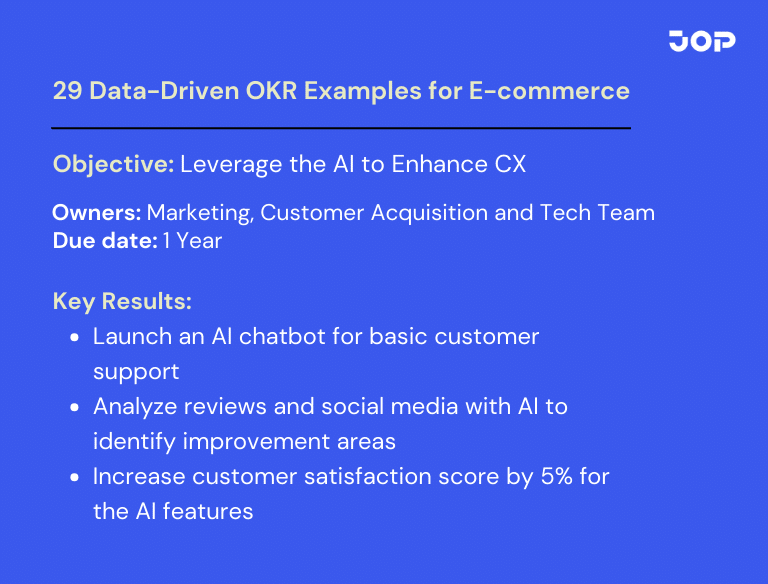
Objective: Use AI to enhance customer experience
Owner: Head of Marketing & Customer Acquisition & Technology and Development
Period of time: 1 year
Key Results:
Objective: Adapt to evolving customer behavior by tracking trends and preferences
Owner: Head of Marketing & Customer Acquisition
Period of time: 1 year
Key Results:
Objective: Improve return process to boost satisfaction and reduce return rates
Owner: Head of Customer Service
Period of time: 3 months
Key Results:
Objective: Increase customer satisfaction score by 10% with faster, more helpful service
Owner: Head of Customer Service
Timeline: 1 year
Key Results:
Objective: Improve customer satisfaction with faster delivery and free shipping options
Owner: Head of Fulfillment & Logistics
Timeline: 6 months
Key Results:
Objective: Streamline the return process with hassle-free options
Owner: Head of Fulfillment & Logistics & Customer Service
Timeline: 3 months
Key Results:
Objective: Strengthen the logistics network to ensure efficient and cost-effective order fulfillment
Owner: Head of Fulfillment & Logistics
Due Date: 1 Year
Key Results:
Objective: Build strong supplier relationships for timely delivery and better pricing
Owner: Head of Fulfillment & Logistics
Timeline: 1 year
Key Results:
Objective: Strengthen customer data security with robust measures
Owner: Head of Technology & Development
Timeline: 1 year
Key Results:
Objective: Improve mobile experience to boost engagement and conversions
Owner: Head of Technology & Development
Timeline: 1 year
Key Results:
Objective: Stay compliant with evolving data privacy regulations
Owner: Head of Technology & Development & Legal Department
Timeline: 3 months
Key Results:
Objective: Use data analysis to find and achieve at least 5% cost savings
Owner: Head of Finance & Accounting
Timeline: 1 year
Key Results:
Objective: Optimize pricing strategies to boost profitability
Owner: Head of Finance & Accounting & Marketing and Customer Acquisition
Timeline: 1 year
Key Results:
Objective: Improve recruitment to attract and hire top talent
Owner: Head of Human Resources
Timeline: 1 year
Key Results:
Objective: Foster a positive work environment to retain top talent
Owner: Head of Human Resources
Timeline: 6 months
Key Results:
Objective: Support employee growth with continuous upskilling opportunities
Owner: Head of Human Resources & Department Heads
Timeline: 1 year
Key Results:
I’ve seen firsthand that no e-commerce team can do everything alone. Marketing can bring in traffic, but without operations and customer service in sync, growth stalls. And that’s where OKRs come in, and helps to connect the dots and get everyone moving toward the same goal.
The best part? OKRs turn big goals into clear steps each team can take. Sales, product, finance everyone sees how their work fits the bigger picture.
Setting the right OKRs can be tiring, but that’s what we assist with. Our consultants collaborate with you to define OKRs that are not only targets, but actually growth tools.
If you’re ready to align your teams and move with velocity, let’s connect.
OKRs are a framework that breaks big business goals into clear objectives and measurable results. They help teams know exactly what to achieve and how success will be tracked.
They align all departments, prevent teams from working in silos, and keep everyone focused on the same business priorities. This leads to faster, more sustainable growth.
Quarterly reviews are common, with regular check-ins to track progress. This ensures teams stay on course and can adapt quickly if needed.
Yes, OKRs aren’t just for large companies. They help small teams stay focused, prioritize better, and compete effectively in fast-moving markets.

CEO of JOP
Gaurav is the CEO of JOP (Joy of Performing), an OKR and high-performance enabling platform. With almost two decades of experience in building businesses, he knows what it takes to enable high performance within a team and engage them in the business. He supports organizations globally by becoming their growth partner and helping them build high-performing teams by tackling issues like lack of focus, unclear goals, unaligned teams, lack of funding, no continuous improvement framework, etc. He is a Certified OKR Coach and loves to share helpful resources and address common organizational challenges to help drive team performance. Read More
Keep up with OKRs and related resources
The evidence behind high-performing teams
In-depth resources for high performance
Easy best practices for OKRs
Unlock your growth potential with expert takes
Collection of OKR Templates for your business
Explore reviews of top software solutions
Get unique insights from the experts
Explore the best OKR & Performance Management alternatives
Uncover the best OKR software comparisons
An OKR starter course for your team


