 Gaurav Sabharwal
Guide to Objective and Key Results – OKR Meaning and Examples
It starts young when people around you ask, “When you grow up, what do […]
I have been in meeting rooms where each team boldly shared their objectives, to find out halfway through that none of them aligned. Marketing was pursuing one, product another, and customer service was steering in a totally different direction. Ring a bell?
That’s the risk when goals do not cascade. Effort becomes dispersed, opportunities get lost, and burnout sets in because the work is not connected to the greater purpose.
The best news? With the correct OKR cascading system, some input from your team, and backing from OKR management software, you can link the dots. Everyone pulls together in the same direction, rowing steadily towards the same North Star.
In this blog, I’ll share the practical steps, tips, and a real OKR cascade example that successful companies use to align strategy with execution from leadership’s vision all the way down to individual goals.
I still recall the first time I heard the term “OKR cascading.”
At first, it sounded like another jargon. But when I saw it in practice, it totally transformed the way I thought about alignment in a company.
Here’s how I view it. Cascading OKRs is like taking a grand vision and gradually zooming in until every single person knows exactly where they fit.
It begins at the top: the company OKRs. That’s where the “why” resides: the direction, the purpose, the big story we’re all writing together.
Then there’s the second step. Not leadership dictating targets, but actual conversations where departments and teams ask, “What part of this vision can we own?” It’s in these moments that goals cease to be abstract and begin to become real.
Finally, it gets personal. Each person writes their own OKRs, and suddenly the dots connect. You can look at your day-to-day work and see exactly how it contributes to something bigger. That’s powerful.
But cascading is more than writing goals on paper. It’s about keeping the story alive: sharing OKRs openly, monitoring progress together, and celebrating wins across every level. When done correctly, it doesn’t feel rigid, it feels unifying.
That’s the real magic of OKR cascading. It’s not about control. It’s about clarity, connection, and ensuring that no matter how large the company gets, we’re all still rowing in the same direction.
When others discuss “OKR cascading,” it may sound a bit heavy.
But in fact, it’s quite simple: ensuring everyone’s work ties into the larger context.
Let’s step through an example.
You work at TechSolutions (assume), a software product company. The leadership team establishes a large company-wide OKR for the upcoming quarter:
Objective: Enhance Product Quality
Now, this is not a pleasant phrase in a slide presentation. It must become real between departments. Here’s how it could trickle down:
The product leader establishes an objective:
KR: Cut reported bugs by 30% this quarter.
To make it tangible, the team doubles up on tighter code reviews, adds peer-to-peer testing, and deploys additional engineers onto bug fixes.
The manager breaks down the company’s OKR into:
KR: Raise customer satisfaction score to 4.5 from 4.2.
The team implements new agent training, accelerates ticket closing, and establishes a straightforward feedback loop to gather what’s annoying customers.
Their approach, the director decides, is:
KR: Raise customer retention rate by 20%.
They foster better relationships with current customers, implement a loyalty program, and execute campaigns demonstrating how TechSolutions’ product enhancements are responding directly to user concerns.
The team lead wordifies it as:
KR: Automate testing for all critical features this quarter.
Thus, fewer bugs make it through to release, directly serving the company’s quality emphasis.
And lastly, the magic occurs when these departmental OKRs trickle down to the individual level.
For instance:
A developer might own the KR: “Write automated test cases for 3 key modules this quarter.”
A support agent may have as a goal: “Resolve at least 85% of tickets in 24 hours.”
Instantly, everyone, from leadership to an individual contributor, can follow the thread. Their work on a given day isn’t merely “tasks.” It’s part of an epic narrative: making TechSolutions’ products better for customers.
That’s what cascading OKRs is all about: alignment to purpose, so nobody’s rowing in the wrong direction.
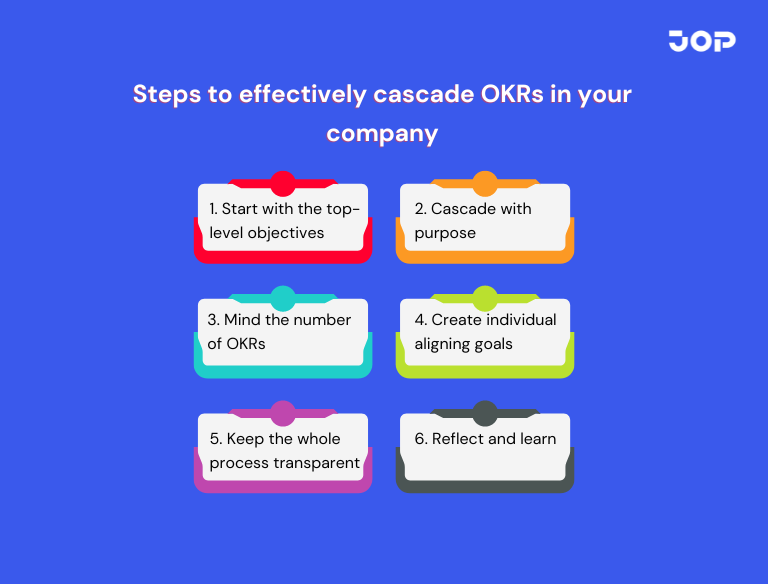
Think of OKR cascading as connecting the dots between your company’s big-picture vision and the everyday work that gets done on the ground. It’s not just about writing goals, it’s about making sure everyone knows exactly how their role contributes to success.
Here are the main steps:
Top-level goals are set by leadership, ambitious in nature and associated with the vision. These serve as everyone’s North Star.
Here’s where OKR software comes in handy.
Example: “Grow user engagement by 20% this quarter.”
Departments define their own objectives that contribute directly to company goals. This results in clarity and ownership.
Example: Marketing establishes “Grow online sales by 20% through campaigns.”
Keep OKRs limited to 3–5 per team and 3–5 KRs per goal. Fewer, more focused goals generate stronger results.
Focus directs energy into what is most important.
Team members tie personal OKRs to the team goals. Bottom-up feedback adds ownership and realism.
Example: “Boost app rating from 4.2 to 4.5” or “Decrease crashes by 20%.”
Make OKRs transparent throughout the company, assign owners, and monitor openly. Openness encourages accountability and teamwork.
Everybody is aware of what belongs to whom and where progress is headed.
Check periodically, change when priorities change, and apply feedback to refine.
OKRs must be fluid, making teams nimble and responsive to shifting realities. Using a performance management tool can help streamline this process by tracking progress, centralizing feedback, and providing data-driven insights.
Here are some straightforward tips to make OKR cascading more impactful for your team.
Code for America, a non-profit, aimed to solve a maddening fact: too many low-income Americans still encounter delays and bureaucratic hurdles to get necessary services such as housing, medical care, or erasing criminal records.
Their charge was ambitious, demonstrating that government services could be easy, straightforward, and efficient.
We took this story from whatmatters.com
One of their best-known programs, Clear My Record, began by linking individuals up with public defenders in California. Demand rapidly grew beyond capacity, however. In 2017, the team constructed a prototype that allowed applicants to represent themselves without an attorney, and in 2018 they scaled it further with automation.
How did OKR cascading drive this success, then?
At the board level, they established a North Star: “Clear all eligible records.” Then, goals cascaded down aiming at 250,000 convictions cleared in 2019. Teams divided this into smaller, manageable OKRs: enhance automation, increase partnerships, and enhance outreach.
For instance, marketing pushed awareness growth, engineering developed sophisticated automation to manage more records, and outreach won new government partnerships. With this coordination, they achieved real victories, such as averaging 350 cleared applications per week in a single quarter.
Above all, OKRs provided them with the flexibility to respond as legislation and technology evolved. Rather than adhering to set plans, cascading OKRs held each team to the same North Star while innovating on their own scale.
This strategy since 2009 has enabled Code for America to turn around government practices once deemed “unfixable” illustrating the full potential of cascading OKRs in addressing ambitious, systemic challenges.
A completely rigid OKR cascading in your organization can hinder your team’s creativity and motivation to work toward their cascaded respective OKRs. Let’s understand how, by creating a balance between cascading and bottom-up goals, you can help your team perform better.
Imagine this: your objectives cascade from the top and are designed to flow smoothly down the line. Sounds great, doesn’t it? But often, those cascading objectives lose relevance as they trickle down. If teams don’t align with them, it causes confusion and low energy.
Another challenge is rigidity. A target cascade that’s too strict can’t adapt quickly to change or new insights. That’s why many teams find pure cascading OKRs difficult to sustain.
Cascading OKRs work best when your company has a clear vision and strategy set by leadership. In such cases, cascading objectives examples such as aligning team goals to revenue or customer satisfaction, ensure everyone is heading in the same direction.
When team tasks align easily with higher-level ambitions, a formal OKR cascade example maintains focus and alignment.
Top-down cascading objectives give the “North Star”, everybody aligns to strategy. But combining bottom-up input provides teams with a sense of ownership and fuels innovation.
For example, leadership might initiate a goal of “Increase customer satisfaction by 10%.” With bottom-up alignment, teams might propose solutions such as additional feedback loops or more robust support infrastructure. Together, this creates tangible, impactful cascading OKRs.
Here’s how to cascade OKRs successfully with flexibility maintained:
Begin with well-defined top-level goals – Define and communicate organizational priorities.
Involve bottom-up input – Allow teams to contribute ideas to ensure cascading OKRs are possible and motivating.
Align with strategy – Make sure each cascading goal has a connection back to company priorities.
Have open communication – Openness enables teams to stay motivated and accountable.
Review and adjust – Regular meetings see OKRs remain relevant as conditions evolve.
OKR cascading can be effective to streamline activities and keep everyone on the same page, but it is most effective when approached as a participatory process rather than solely a top-down task.
Transparency, involvement, and flexibility are essential to make cascading OKRs effective and meaningful.
Get your teams to collaborate, make necessary changes in goals, and toast milestones along the way. And in case you need professional advice on how to cascade OKRs successfully, our OKR consultants are at your beck and call.
It creates alignment, clarity, and focus. Cascading goals help teams see how their work impacts company success and reduce scattered or conflicting priorities.
No. A mix of top-down direction and bottom-up input works best. Leadership sets the vision, while teams suggest practical, innovative ways to achieve it.
Too much rigidity, loss of context as goals move down the chain, and lack of buy-in from teams. This can reduce motivation and slow adaptation to change.
4. How many OKRs should cascade down?
Best practice is 3–5 objectives per team with 3–5 key results per objective. This ensures focus without overwhelming people.

CEO of JOP
Gaurav is the CEO of JOP (Joy of Performing), an OKR and high-performance enabling platform. With almost two decades of experience in building businesses, he knows what it takes to enable high performance within a team and engage them in the business. He supports organizations globally by becoming their growth partner and helping them build high-performing teams by tackling issues like lack of focus, unclear goals, unaligned teams, lack of funding, no continuous improvement framework, etc. He is a Certified OKR Coach and loves to share helpful resources and address common organizational challenges to help drive team performance. Read More
Keep up with OKRs and related resources
The evidence behind high-performing teams
In-depth resources for high performance
Easy best practices for OKRs
Unlock your growth potential with expert takes
Collection of OKR Templates for your business
Explore reviews of top software solutions
Get unique insights from the experts
Explore the best OKR & Performance Management alternatives
Uncover the best OKR software comparisons
An OKR starter course for your team


